Accessibility in Glacier National Park: A Guide for Disabled and Wheelchair-Bound Visitors
Planning a Glacier National Park trip with a disability? This comprehensive accessibility guide covers ADA-friendly trails, lodging, and elopement options for wheelchair users and travelers with chronic pain or mobility needs.
Table of Contents
- Is Glacier National Park Wheelchair-Friendly?
- What Is a Disability—and What Does the ADA Actually Do?
- Getting Around Glacier National Park
- Wheelchair-Friendly Trails & Boardwalks
- ADA-Compliant Lodging & Restaurants
- Accessible Activities Beyond Hiking
- Know Before You Go
- Accessible Trails Outside Glacier
- Thinking of Eloping? Glacier is Still the Ultimate Place for Couples on Wheels
- 🌿 Access and the Outdoors: A Note on Eco-Crip Theory
- Final Thoughts
Glacier is awe-inspiring—but it’s also intimidating, especially if you move through the world differently. If you use a wheelchair, walk with a cane, or live with chronic pain or invisible disability, it’s hard to know what’s possible until you get there—and planning shouldn’t be that stressful. This guide is here to change that.
As someone who works with couples of all abilities and sees the emotional weight of access on wedding planning and travel, I built this for you. Whether you’re dreaming of a mountain ceremony or just want a peaceful overlook to sit and take it all in, you belong here.
Glacier National Park lies on the ancestral homelands of the Blackfeet, Salish, Kootenai, and Pend d’Oreille Peoples. As we honor their lasting stewardship, we also recognize that true belonging means making this land accessible to all—regardless of ability, background, or identity.
Is Glacier National Park Wheelchair-Friendly?
Accessibility in Glacier National Park has come a long way, with paved paths, boardwalks, and accessible shuttles—but many visitors still face uncertainty about which trails, services, and lodging cater to their needs. This guide is for you: a detailed, traveler-first rundown of how to experience Glacier with comfort, dignity, and freedom. Learn more about NPS Glacier Accessibility.
What Is a Disability—and What Does the ADA Actually Do?
Under the Americans with Disabilities Act (ADA), a disability is defined as a physical or mental impairment that substantially limits one or more major life activities. That can include mobility disabilities, chronic illnesses, sensory impairments (like vision or hearing loss), neurological conditions, mental health disorders, and many others—visible or not.
Passed in 1990, the ADA is a civil rights law that prohibits discrimination based on disability. It requires public places—including national parks—to provide equal access and reasonable accommodations so disabled people can participate fully and with dignity.
In short: the ADA protects your right to access public lands like Glacier National Park—whether you use a wheelchair, live with chronic pain, experience anxiety, or move through the world differently in any number of ways. If you self-identify as disabled, you belong here. Period.
Getting Around Glacier National Park
ADA Parking & Entrance Passes
The National Park Service Access Pass is free for U.S. citizens with permanent disabilities and covers park entrance fees. With the proper documentation you can pick one up in person at the Hungry Horse Forest Service Ranger Station just minutes outside Glacier’s West Entrance (no appointment needed), or any of these nearby locations. You can also order online, but expect to pay about $10 in shipping/handling.
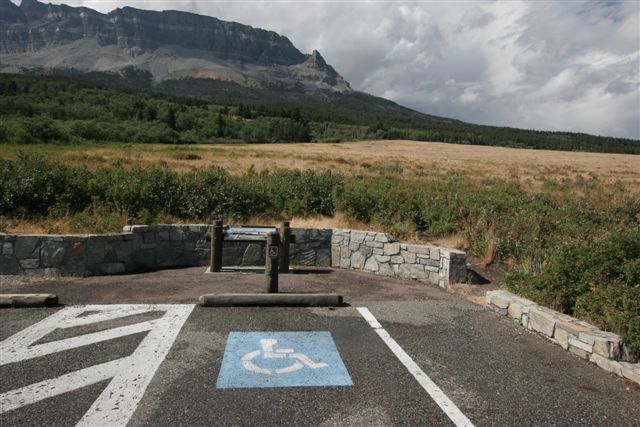
You’ll find ADA parking at all major trailheads and visitor centers. Look for the blue signs and—pro tip—aim to arrive before 9 a.m. during peak season to snag a spot.
Are Vehicle Reservation Required for ADA Visitors?
Vehicle reservations (for Going-to-the-Sun Road and North Fork) are required for all visitors—ADA tags don’t override reservation rules.
If you didn’t snag a vehicle pass 180 days out on Recreation.gov, you still have options. At 7PM MDT the night before your targeted Going-to-the-Sun Road or North Fork day, 25% more passes will be let loose on the booking page. Passes cost a nominal $2 for processing and can be displayed on a mobile device instead of printing.
If that fails, you can still access the pass-restricted areas as long as you get there outside of restricted hours. For 2025, the hours are 7am-3pm, meaning if you arrive to the vehicle-pass-check-station at 6:45am or 3:15pm, you no longer need one. Additionally, GTTSR can be accessed at any time via the St. Mary entrance, since so few people are willing to drive the long way (2.5hrs) around the park. This is ideal for folks camping at Two Medicine or in East Glacier. Like I said, options.
Pro Tip: Come in at 5pm, pack a picnic dinner and watch the sunset over Big Bend when all the other travelers have headed back to their hotels for supper.
Accessible Shuttle System (Free)
ADA-accessible shuttles (ramps or lifts) run along Going-to-the-Sun Road between Apgar Visitor Center and Logan Pass, and Logan Pass and St. Mary Visitor Center. Shuttles are free for park guests, first-come-first-served, and run from July 1 through Labor Day, with the possibility of extended service into mid-September. Shuttles typically arrive/depart every 15-30 minutes; bear in mind you may have to wait at popular stops for a second shuttle, as space is limited.
Red Bus Tours – Still an Option!
The historic 1930’s Red Buses of Glacier National Park are not wheelchair-accessible, but the park’s concessionaire, Xanterra, also has two wheelchair-accessible vehicles, painted red to match the fleet. They are equipped with a lift and two-wheelchair spaces with tie-downs, and are otherwise fairly similar to the free shuttles. They generally spend a little more time at accessible stops like Logan Pass and Trail of the Cedars to ensure plenty of time to enjoy the space. Tours leave from both Apgar and St. Mary visitor centers. You will want to book your reservation early though, since these are incredibly popular guided tours and can only accommodate a few people per day. Email redbustours@xanterra.com for more information.
Sun Tours – Guided Vehicle Tours via GTTSR
A Blackfeet-owned business based out of East Glacier, Sun Tours offers interpretive tours with an essential indigenous perspective. You’ll not only have a guided tour through the park led by local experts, you’ll have the oppotunity to learn about Blackfeet heritage while traversing their ancestral homeland. Wheelchair-accessible vehicleas are available upon request and advance reservations are required. Their tours begin at both Apgar and St. Mary visitor centers.
Getting to Glacier National Park by Train
Wheelchair-accessible rail service is available to Glacier National Park via the Empire Builder route that runs from Chicago to Seattle. Amtrak has train stations in both West Glacier and East Glacier, and features an on-board lift. Station lifts are available at both Glacier park stations also. The ride from Seattle is an overnight, but the ride from Chicago is ~30 hours, depending on weather.
Once you disembark, there is a shuttle service in West Glacier operated by the park’s main concessionaire, Xanterra, that will take you between Lake McDonald Lodge and Apgar Village Inn, but you do need to make a reservation for the service. The East Glacier station is directly across from the Glacier Park Lodge and they will pick up lodge guests with a call-ahead.
Wheelchair-Friendly Trails & Boardwalks
While this is not a comprehensive list and is based mostly on my personal experience, I hope it will give you an understanding of what to expect when visiting some of our wonderful nature walks. Learn more about the top ADA-compliant trails in Glacier.
Trail of the Cedars (Avalanche Area)
This mossy, cathedral-like forest trail is flat, paved, and magical—especially in the morning. Wheelchair users will appreciate the smooth loop (with some gentle tree-root buckling), and everyone loves the creek that flows right under the boardwalk.
- 0.7-mile wheelchair-accessible loop through forests and glacier-fed creeks. Paved path, gentle grades. Please note the paved areas can be uneven due to root growth.

Wild Goose Island Overlook
One of Glacier’s most iconic views, this short paved pull-off offers breathtaking scenery without the need to hike. From the overlook, you’ll see a tiny island floating in St. Mary Lake, surrounded by dramatic peaks—perfect for portraits, picnics, or just soaking in the alpine beauty.
McDonald Falls
An easy roadside pull-off along Going-to-the-Sun Road, McDonald Falls offers a dramatic view of glacier-fed rapids rushing through moss-covered rocks. The path from the parking area is paved and flat, making it wheelchair-friendly and ideal for a peaceful pause. The sound of rushing water and filtered mountain light make this a calming place to just be still.
Apgar Village & Lake McDonald Lodge Area
Apgar is the heart of Glacier’s west side—bustling yet peaceful, and one of the park’s most accessible hubs. The visitor center offers ADA parking, level entrances, accessible restrooms, and interpretive exhibits. Just steps away, you’ll find paved walkways leading through Apgar Village, down to the lakeshore, and to an accessible fishing pier on Lake McDonald. It’s an easy place to grab a coffee, learn about the park, and take in the view with your wheels on solid ground. They also have accessibility brochures you can take, which highlight their most ADA-friendly sites. Since there’s no cell service past this spot, this recourse is gold!
- Flat, paved lakeshore path and accessible fishing pier. ADA restrooms on-site.
- Please be mindful of uneven historical flooring in the lodge.
7-Mile Pullout
This pullout is, you guessed it, about 7 miles up the road from Apgar and has a lovely view of the mountains. This pullout is unfortunately not well marked but has a decent amount of parking and a ramp down to a bench near the lake. The path then quickly turns to beach/pebbles, but the ramp area still has a lovely view of the beach and water.
Oberlin Bend
Tucked near the summit of Logan Pass, Oberlin Bend offers sweeping alpine views without needing to hike. There’s a short paved path leading from the parking area to a stone-walled overlook—perfect for spotting mountain goats or soaking up a golden sunset. Even during busy season, this spot often feels quiet and serene in the early morning or late afternoon.
Logan Pass Visitor Center
This is Glacier’s crown jewel for accessible mountain views. A wide paved path leads to a panoramic terrace where wildflowers bloom beneath towering peaks. From late June through early September, the terrace is buzzing with marmots, tourists, and that signature Logan Pass wind. It’s a great spot to take a break, watch clouds roll through the valleys, and feel totally immersed in the alpine landscape—no hike required.
- Ramp access and paved deck—ideal for mountain and wildlife viewing without hiking.
- Limited ADA parking—come early or use shuttle.

St. Mary Visitor Center
At the eastern gateway to Going-to-the-Sun Road, the St. Mary Visitor Center is modern, scenic, and fully ADA-compliant. It offers accessible exhibits, paved pathways with stunning views of the St. Mary Valley, and one of the best intro spots to Glacier’s cultural and ecological story. It’s also one of the main shuttle stops on the east side, with wheelchair-accessible options during peak season. Perfect for sunrise or a peaceful stop before heading deeper into the park.
- Fully accessible facilities, interpretative exhibits, and short level trail with scenic views.
Two Dog Flats Overlook
Located just beyond the St. Mary entrance, this lesser-known roadside pullout delivers jaw-dropping views of open plains rolling into alpine peaks. There’s ADA parking and a flat surface to set up a tripod, have a picnic, or simply breathe in the scale of Glacier. It’s a favorite for sunrise light and wide-open skies—and a beautiful place to feel both grounded and free.

Many Glacier Hotel Grounds & Dock
Perched on the edge of Swiftcurrent Lake and framed by jagged peaks, Many Glacier Hotel feels like stepping into a Swiss Alps fairytale. The paved pathways around the hotel and down to the dock are wheelchair-friendly, making it one of the most scenic and accessible lakeside spots in the park. Grab a coffee from the gift shop, watch the boats glide across the water, or just sit and soak in the sunrise. The historic hotel books up fast, especially the ADA rooms—so plan ahead if you want to stay in the heart of this spectacular east-side region.
- Paved areas with lake-front access. Lodge rooms may need early booking.
Swiftcurrent Nature Trail
This trail is about 2.5 miles in total and made of packed dirt usually 6ft wide, circling Swiftcurrent Lake. The most accessible part is the first .25mi which goes through a wonderfully wooded forest with vistas of the lake and Many Glacier’s Swiss-style lodge which can truly take your breath away. I cannot personally confirm if the entire loop is wheelchair-friendly as I haven’t been out there recently, but online resources are saying “mostly accessible”. Even if you just do the first .25mi, the trail is lovely. Also, the trailhead has one accessible parking space.
Note: The trailhead parking lot is closed for construction in 2025 and access is limited to a shuttle service from Many Glacier Hotel.
Running Eagle Falls (Two Medicine Area)
Known as Trick Falls for its unique double-drop effect in spring, Running Eagle Falls is one of the most accessible and meaningful spots in Glacier. A gently packed gravel trail—ADA-compliant for most wheelchairs—leads you through a serene forest to a crystal-clear waterfall pouring from the heart of the mountain. The trail is short, peaceful, and powerful, making it one of the best places in the park for reflection, photos, or a quiet vow exchange.
- ADA-compliant path of packed rock up to the river crossing, with a view of the waterfall. The path continues over a small log-bridge that is not wheelchair friendly.
Goat Lick Lookout
Tucked just off Highway 2 near the southern edge of the park, Goat Lick Lookout is a quiet, paved viewpoint overlooking a mineral-rich riverbank where mountain goats often gather. The path is short, flat, and easy to access—even for wheelchairs—and the views are wide open and peaceful. It’s an ideal roadside stop for wildlife spotting, especially in the early morning or evening when the goats are most active.
- located on Highway 2 about 2.5 miles east of the Walton Ranger Station, is a stunning vista overlooking riverbank. The paved path is short and often uncrowded.

ADA-Compliant Lodging & Restaurants
Accessible Lodging in and Around Glacier
Finding a place to rest your head shouldn’t feel like a compromise—and in Glacier, it doesn’t have to be. From historic park lodges with ADA-accessible rooms to charming nearby inns with thoughtful touches, there are options that combine comfort, character, and inclusivity. Whether you’re sipping coffee on a lakeside patio or rolling right up to your cabin door, these stays help you feel grounded, welcome, and ready for adventure. Just be sure to book early—accessible rooms are limited and Glacier is wildly popular for a reason.
- “In the Park” Accessible Lodging:
- Lake McDonald Lodge & Village Inn at Apgar: ADA ground-floor rooms and paved walkways.
- Many Glacier Hotel: Accessible guest rooms and accessible dock area (book 9–12 months in advance).
- Belton Chalet (West Glacier): ADA-certified rooms, ramps, and accessible dining.
- Glacier Park Lodge
- Lake McDonald Cabins
- Rising Sun Motor Inn
Accessible Camping in Glacier
If you dream of sleeping under the stars with the scent of pine in the air and mountains on the horizon, Glacier makes it possible—with accessible campsites designed to welcome every kind of adventurer. Most campgrounds in the park offer designated ADA sites close to restrooms and with level ground for easier setup. Whether you’re in a tent, campervan, or RV, you can enjoy the simple joy of a crackling campfire and quiet dawns—no need to hike miles to feel immersed in nature. Just remember: accessible sites are held for guests with disabilities until 6 PM daily, so plan ahead to claim your perfect spot. Make your reservation at Recreation.gov. (I’ve pre-filtered that link to ADA campgrounds)
Currently, only the following campgrounds within Glacier National Park are listed with Accessible campsites:
- St. Mary Campground
- Apgar Campground
- Avalanche Campground
- Fish Creek Campground
- Sprague Creek Campground
Outside of the park, the St. Mary KOA is a crowd favorite and also has ADA campsites.
Accessible Restaurants & Dining
Almost all of the restaurant options inside the park are located within the historic lodges, and fortunately few require reservations. There are unfortunately not any food options in between Lake McDonald Lodge and Saint Mary, however, and the drive through Going-to-the-Sun Road often takes people 2-5 hours which can be a long time if you’re not prepared. Remember to bring plenty of snacks for everyone in your party, especially if you get low blood sugar easily.
Here are some of my favorite restaurant options in and around the park, all of which are Accessible:
Ptarmigan Dining Room at Many Glacier Hotel – a great spot for families, serving classic American and regional Montana dishes, with the best view in the park, overlooking Swiftcurrent Lake.
Russell’s Fireside Dining Room at Lake McDonald Lodge – offers a wide variety of kid-friendly meals and local dishes in a wheelchair-accessible dining room.
Glacier National Pizza – a counter-service outdoor pizza joint in the West Glacier plaza that serves ’em hot and by the slice. Well worth a visit, and probably the most delicious $5 you’ll spend all day.
Two Sisters Cafe – located in Babb just outside of East Glacier, a Blackfeet-owned and operated cafe-restaurant duo serving pastries and coffee until 3pm and dinner service after. This restaurant serves all Montana’s staples, including trout, elk, huckleberries, and wild bison from the tribal herd. All other bison you’ll find in Montana is farm-raised, so this is truly a unique offering.
Accessible Activities Beyond Hiking
- Watch the most breathtaking sunset over Big Bend
- Skip rocks by the many alpine lakes
- Wildlife viewing & bird watching at Oberlin Bend overlook
- Stargaze at a Ranger-led Astronomy Program at the Dusty Star Observatory or Logan Pass
Fun Fact: Glacier has been designated an International Dark Sky Park by Dark Sky International, so one of the most special activities in the park is watching the Milky Way rise over the mountain peaks. There’s even a live webcam of the Dusty Star Observatory so you always have access to the sky.
Know Before You Go
- Logan Pass parking is first-come—arrive early or ride shuttle.
- Historic lodges may have uneven floors—ask when booking.
- Cell signal is limited—download offline maps.
- Radio is also limited. Your only choice is FM 95.9 “Outlaw Country” which plays a delightful mix of oldies country.
- Wildlife is present even at accessible areas—stay alert and keep distance.
- Cash is not accepted in the park, so have credit or debit options available.
Borrow Adaptive Equipment & Assistive Tech for Montana Residents
If you’re a Montana resident, be sure to look into the MonTECH program at the University of Montana. They provide technology, support, and services that improve the quality of life for Montanans with disabilities and may help you get the most out of your visit to Glacier National Park.
Montanans can borrow assistive technologies and adaptive equipment, or receive free, one-to-one help learning about devices that support independence. MonTECH can also ship most items to anywhere in Montana, including the Glacier area, free of charge.
Who can use MonTECH? Any Montanan, any age, with any physical or cognitive challenge including learning disabilities and impairments associated with aging.
Accessible Trails outside of Glacier National Park
Let me share a secret…some of my favorite Montana treasures are outside the park! If your lodging is in Kalispell or Whitefish, you are very close to some amazing (and accessible) nature trails within the Flathead National Forest and Kootenai National Forest. Even if hiking isn’t your jam, these pathways provide an excellent opportunity for birdwatching, fishing, and meditation. Here are a few highlights:
- Great Northern Rail Trail – built on a decommissioned Great Northern Railroad route and covering 22 miles of paved trail between Somers, Kalispell and Kila. Lots of parking lots to customize this trail based on your needs and endurance.
- Krause Basin Interpretive Trail – a 0.25-mile compact gravel loop path with a dozen informative stations to learn about the old-growth hemlock forest.
- Lone Pine State Park – overlooks the incredible Flathead Valley and offers an all-terrain wheelchair available for use free-of-charge on the Lone Pine trail system and the ADA accessible overlook. Contact the Visitor Center at 406.755.2706 for a reservation.
- White Memorial Loop – also in Lone Pone State Park, a 0.3-mile loop offering views of Flathead Lake, Big Mountain and Glacier National Park.
Further out, but still worth a visit if you’re in the area:
- Polson Interpretive Trail – a paved 1.1-mile out-and-back trail along the shores of Flathead Lake. This trail is a bit further south from the general Glacier area, but is a great stop if you’re headed back to Missoula.
- Little North Fork Falls – a 0.8-mile out-and-back trail to a waterfall near Lake Koocanusa near Libby, MT. This is FAR from Glacier, but very beautiful and peaceful. I’ve never seen another soul there when I go.
- Little Therriault Lake Trail – a .9 mile loop of compact gravel meandering around the lake. This is true unfettered Montana wilderness. It’s also very near the border crossing in Eureka. I’ve only stopped here on my way to Banff National Park, but again, never any people.
Thinking of Eloping? Glacier Is Still the Ultimate Place for Couples on Wheels
You don’t need to hike miles into the backcountry to have a breathtaking wedding in Glacier. The park offers several gorgeous, ADA-accessible ceremony spots—so you can say “I do” surrounded by mountain peaks, alpine light, and the wild beauty of Montana, all without compromising access or intimacy.
♿ Best ADA-Friendly Elopement Locations in Glacier
For Sunrise:
- Lake McDonald Shoreline (Apgar Village)
With paved walkways and vehicle access right to the water’s edge, this location offers peaceful early morning light, still reflections, and accessible restrooms nearby.
For Sunset:
- Wild Goose Island Overlook (St. Mary side)
A short, paved path leads to this dramatic overlook, ideal for golden-hour vows or portraits. There’s ADA parking directly at the pull-off.
Bonus:
- Logan Pass Viewing Terrace
Although the parking fills up quickly, the paved viewpoint here offers jaw-dropping mountain views and wildflowers in summer. It’s also one of the most iconic backdrops in the park.
⚠️ Pro tip: Ceremony permits are still required for most Glacier elopements—even on paved sites. Learn more in my guides for Best Elopement Locations and Elopement Planning Guide (link coming soon!).
Post-Elopement Ideas That Don’t Require a Hike
After your ceremony, spend the day soaking up everything Glacier has to offer—on wheels, at your own pace. Here are a few ways to celebrate:
- Scenic drive along Going-to-the-Sun Road (with photo stops)
- Accessible boardwalk stroll at Trail of the Cedars
- Picnic by the lake at Apgar or Two Medicine
- Private boat rental on Lake McDonald or St. Mary Lake (ask about wheelchair-accessible docks)
- Red Bus portrait session — even if the vintage buses aren’t accessible for transport, they’re iconic for photo ops
You don’t have to “opt out” of wild landscapes, meaningful experiences, or a wedding that feels deeply you—just because you move through the world differently.
If you’re dreaming of an elopement in Glacier National Park, I’m here to help you plan, navigate, and celebrate every step of the way.
📸 Contact me here to start planning your accessible Glacier adventure elopement.
Let’s create something real, joyful, and true to your love.
🌿 Access and the Outdoors: A Note on Eco-Crip Theory
When we talk about accessibility in wild spaces, it’s easy to fall into a false either/or—either we protect the environment, or we make it accessible. Eco-crip theory challenges that binary.
Eco-crip theory is a framework at the intersection of disability justice and environmentalism. It asks: Who gets to be in nature? Who is it being preserved for? And how can we design outdoor spaces in ways that include disabled people, rather than excluding them in the name of purity or preservation?
Many disabled people have deep relationships with nature. Access to wild places—whether by trail, boardwalk, audio guide, or parking lot—isn’t a luxury. It’s a civil right. Inclusion and sustainability are not opposites. They can (and must) coexist.
Not All Disabilities Are Visible
When we picture disability, we often think of mobility aids like wheelchairs or walkers—but the truth is, many disabilities aren’t visible at all. These are called invisible (or hidden) disabilities, and they include a wide range of physical, neurological, and mental health conditions that may not be immediately apparent.
Things like autism, anxiety, ADHD, chronic pain, epilepsy, Long COVID, depression, arthritis, hearing loss, vision impairment, and many more all fall under this umbrella. The impact is real—even if you can’t see it.
Because these conditions are hidden, people living with invisible disabilities often face misunderstanding, stigma, or dismissal. They may be questioned when asking for accommodations, or feel pressure to “prove” they need help. That added emotional burden can be isolating and exhausting.
Let’s break that cycle by avoiding assumptions based on appearance. Disability is not always visible—and everyone deserves respect, empathy, and access, whether you can see their disability or not.
In national parks, these misunderstandings can show up in subtle but harmful ways—like questioning someone’s use of accessible parking, ADA restrooms, or shuttle priority seating just because they don’t “look disabled.” But disability isn’t always visible, and many visitors depend on these accommodations to enjoy the park safely. If someone is using an accessibility resource, assume it’s because they need it—and extend the same respect you would to anyone else.
Final Thoughts
Whether you roll, walk, or life carries you along the trails, you deserve the chance to witness the grandeur of Glacier with ease and joy.
I created this guide for travelers like you—so every glacier glow, alpine sunset, and wildflower moment is yours to claim.
There are so many resources out there to help visitors of all abilities enjoy Glacier and Western Montana. Here are some I found helpful:
Disabled Hikers (nonprofit) Western Montana’s Glacier Country – Accessibility Page (nonprofit) , The Disabled Traveler’s Companion (Advocacy blog), Wonders Within Reach – Accessible Family Adventures (blog), Emerging Horizons – Wheelchair Glacier without a Car (blog), My Bucket Journals – Tips for Accessibility in GNP (blog)


Be the first to comment