Be Bear Aware: Bear Safety in Glacier National Park & your Montana Wedding
Getting married in Glacier National Park often means hiking to somewhere jaw-dropping—whether that’s a short walk to a lakeshore or a multi-mile trek into the alpine. But no matter how far you go, one thing is non-negotiable: being bear aware.
Grizzly and black bears call this place home. You’re in their habitat now—and that’s part of what makes Glacier so wild and unforgettable. But it also means showing up with respect, knowledge, and a healthy dose of preparation.
For expert advice on planning your visit, read my free Ultimate Traveler’s Guide to Glacier National Park.
What Does It Actually Mean to Be “Bear Aware”?
It means hiking like a local. Like someone who understands that safety isn’t about fear—it’s about awareness.
- Yes, you’re in bear country. Even the paved trails can have bear activity.
- Most negative encounters happen when a bear is surprised.
- The best strategy is prevention. Make your presence known. Travel smart. Be ready.
Use this information in this guide to help you plan for your Montana adventure and stay safe while enjoying all that the Treasure State has to offer.
Find more resources about bear safety Glacier National Park and the National Park Service.
How to Tell a Grizzly from a Black Bear
Despite the names, color isn’t always the giveaway—both black and grizzly bears can vary from dark blonde to dark brown to black.
Here’s how to tell the difference:
| Feature | Grizzly Bear | Black Bear |
|---|---|---|
| Shoulder hump | Prominent muscle hump | No hump |
| Face profile | Dish-shaped (concave) | Straight profile |
| Ears | Short and rounded | Taller and more pointed |
| Claws | Long (2–4″) and visible from a distance | Short (under 2″) |
| Size | Larger and bulkier | Smaller and leaner |
Both species are wild and powerful—so treat any bear sighting with equal caution and respect. Knowing the difference makes any wildlife sighting more meaningful and helps you better understand their potential behavior.
What Is Bear Spray, and How Does It Work?
Bear spray is essentially pepper spray designed for big wildlife. It creates a powerful, expanding cloud that affects a bear’s eyes, nose, and lungs—giving you time to retreat. It does not permanently affect the bear and is the MOST effective deterrent. Just imagine if you would keep advancing if you were pepper-sprayed! It’s not a repellent like bug spray. It’s your last line of defense in a close encounter.
- You want it readily accessible (on your hip, not in your pack).
- You’ll only use it if a bear is charging or approaching aggressively.
- Most cans have a range of about 25–30 feet and discharge in 6–9 seconds.
- No, it doesn’t harm the bear long-term—it just deters them.
You can often find bear spray for short-term rental at outfitters around Glacier, but make sure to only rent from reputable businesses and inspect the can yourself. You want to make sure your bear spray is not expired and has never been discharged before, so try to avoid second-hand purchases.
Watch this helpful video about “How to Use Bear Spray” by Montana FWP.
Top 5 Bear Safety Tips for Couples and Guests
1. Carry Bear Spray — and Know How to Use It
(Not in your pack. On your hip. And yes, I’ll teach you.)
This is the number one rule. I always carry spray when I’m photographing, and I’ll gladly show you how to use it before we hit the trail.
2. Hike in Groups
Elopement doesn’t mean isolation — bring your best friend or an officiant. Even if it’s just the two of you, add a guide, photographer (hi, that’s me!), or a couple of friends to your ceremony crew. Bears are more likely to avoid larger, noisier groups. If you’re headed out for a hike in a more remote area and see other hikers ahead of you, try to join their group.
3. Make Noise on the Trail
Especially in brushy areas and around blind corners. Talk, clap, sing your first-dance song—it doesn’t have to be loud, just consistent. Bear bells are okay, but your voice is better.
4. No Food Left Behind
Pack out everything. Even biodegradable snacks like orange peels and sandwich crusts. Fire pits are not an acceptable place to dispose of food waste. Biodegradable ≠ harmless. Crumbs attract critters, and critters attract bears.Bears need an incredible amount of calories to maintain their healthy weight, and pizza and skittles are far more calorie-dense than huckleberries and river trout.
5. Stay Alert
Look for tracks, scat, or overturned rocks. Glacier is wild for a reason. Watch for bear sign like fresh scat, dig marks, or overturned rocks. Trust your gut—if a trail feels a little too wild or silent, it’s okay to turn around.
What If You See a Bear While in Your Car?
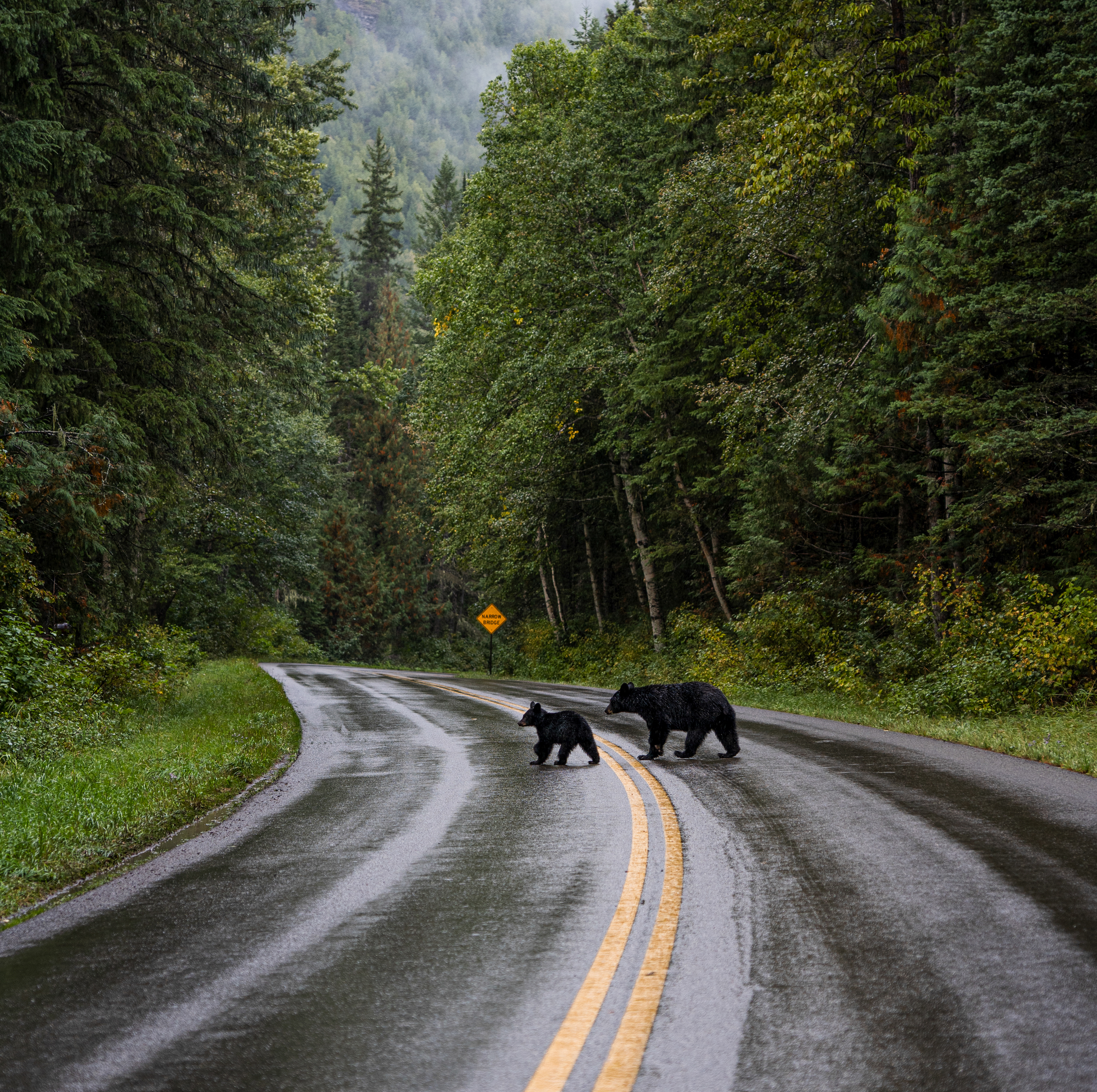
This happens more often than you’d think, especially along Many Glacier Road and Going-to-the-Sun Roads.
- Stay in your vehicle. Never get out for a photo. If the bear is really close, put your window up.
- Don’t block traffic or stop in active lanes—pull fully off the road if you must.
- Give the bear space. At least 100 yards.
- Never feed wildlife. Not even for a “cute” photo. It puts them—and others—at serious risk.
Read: NPS Wildlife Viewing Guidelines
What to Do If You Encounter a Bear on the Trail
Know the difference between defensive behavior and predatory behavior. Defensive bears (surprised, protecting cubs or food) usually ‘bluff charge.’ Predatory behavior (very rare) means the bear follows or stalks—this needs immediate action with your spray.
Here’s how to stay calm and act wisely if you find a bear on one of Glacier’s many trails, based on official Glacier and NPS guidance:
If the Bear is Walking Toward You:
- Step off the trail calmly and let the bear pass.
- If moving away seems to agitate it (head swaying, teeth clacking, huffing), stop.
- Speak softly to let the bear know you’re human.
- Back away slowly—don’t run.
- Avoid direct eye contact (they may see it as a threat).
If the Bear Seems Curious or Keeps Approaching:
- Group together and talk firmly to the bear.
- Make yourselves look big.
- Prepare your bear spray—remove the safety clip and have it ready.
- Don’t allow the bear access to food—secure it immediately.
⚠️ If the Bear Charges or Acts Defensively:
- Stop. Speak calmly. Do not run.
- Prepare your bear spray. Use it if the bear continues to advance within 30ft.
- If contact seems imminent and you don’t have bear spray:
- Lie flat on your stomach.
- Protect your neck with your hands.
- Leave your backpack on for protection.
- If rolled over by the bear, try to stay on your stomach.
- Most defensive bears will leave once they realize you’re not a threat.
- If the attack continues or seems predatory:
- Fight back with everything you’ve got.
- Use rocks, sticks, or fists—this is extremely rare but possible.
- You will avoid this by having bear spray on you and knowing how to use it!
Read the full guidance from the National Park Service
Human Habituation is Bad News Bears!
When you interact with bears, or the bears interact with you, they start to associate humans with good things. This is called habituation and even if the interactions are harmless, the rangers have to intervene out of an abundance of caution for human safety. Many wildlife managers are ultimately forced to re-home and even euthanize bears that have too many human interactions. So please don’t feed the bears.
Learn more about how to Leave No Trace and recreate responsibly. (coming soon)
Bonus Tips for Bear-Smart Elopements
- Leave a food-free “base camp” if you’re hiking far. Pack up all food into bear-proof cans/coolers/cars.
- Don’t let your bouquet sit on the ground unattended (yes, bears like flowers too).
- Avoid sunrise hikes in thick brush alone—early hours are peak bear activity.
Indigenous Perspectives on Bears and Coexistence
In Blackfeet and Salish-Kootenai traditions, the Native peoples whose ancestral homelands covered the Glacier National Park and the Flathead Valley, bears are more than wildlife — they are relatives, protectors, and powerful spiritual beings.
Among the Blackfeet, grizzly bears are considered sacred beings that embody strength and healing power. Some Blackfeet stories speak of bears teaching humans how to use medicinal plants or how to prepare for winter. The bears are referred to as “relatives”—as a literal, respectful way of acknowledging their role in tribal medicine, ceremony, and the natural world .
For Salish, Ktunaxa, and Kalispel peoples, bears are also revered as guardian spirits—reflecting wisdom, protection, and reciprocity with the land. They’re believed to be deeply intuitive and spiritually aware, sometimes even regarded as beings that walk between worlds. Some tribal members carry bear claws or fur not as trophies, but as symbols of spiritual connection, inherited through ceremony.
Learn more about the relationship between bears and Native peoples.
As guests in a landscape that’s been cared for by tribes for millennia, we observe safety guidelines—like carrying bear spray or making noise—to honor those relationships. You’re not just avoiding conflict; you’re acknowledging that bears—a vital part of this ecosystem—deserve caution, consideration, and reverence.
To be “bear aware” is to recognize that these creatures belong here — just as you do, temporarily. And with a little respect, awareness, and humility, we can all coexist safely.
Final Thoughts on Bear Safety: Be Brave, Smart, and Bear-Aware
As your photographer, I’m always scouting and taking precautions to keep everyone safe. You should feel confident hiking into nature — not worried. With a little knowledge and preparation, you’ll feel empowered and aware, not scared.
Being bear aware doesn’t mean being afraid—it means being in tune with the land. And that’s what this whole day is about, right? Connection. Respect. Adventure with open eyes. Seeing a bear (and even a cub!) on your wedding day is truly a blessing from the Earth, and bears just want to live in the neighborhood in peace.
I’ve photographed couples on quiet trails where we were the only humans for miles, and we felt safe, present, and totally in awe. That’s possible for you too—with just a few extra precautions and a good plan.
Want help picking a stunning trail with low bear activity and high wow-factor?
Contact me here and I’ll help you plan an unforgettable (and safe) Glacier elopement from the ground up.


Be the first to comment